Read this article in 中文 Français Deutsch Italiano Português Español
How Saudi Arabia is engaging with international contractors to deliver Vision 2030 megaprojects

08 December 2025
When executives from some of the world’s top construction companies and industry bodies gathered in Paris for this year’s CICA annual conference in late November, there was a prominent new addition in its ranks.
Earlier in the week, the Confederation of International Contractors’ Associations (CICA) confirmed that the Saudi Contractors Authority (SCA), which regulates Saudi Arabia’s construction industry, had become its latest member.
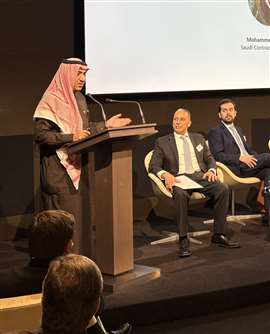 Mr Mohammed Alajlan, chairman of the Saudi Contractors Authority (SCA), speaking at the CICA annual conference in Paris, France (Image courtesy of CICA)
And if there were any doubt about the scale of construction work underway in Saudi Arabia, Mr Mohammed Alajlan, chairman of the SCA and one of the keynote speakers at the conference, explained how a total of $1.7 trillion is expected to be spent in the sector between 2023 and 2030.
Construction spending is estimated to hit a peak this year, at a total of US$260 billion, declining slightly in 2026 at $240 billion and again to $237 billion in 2027.
Nonetheless, the sums involved are vast. Over $500 billion is being invested in the special economic zone of Neom, $40 billion in the Qiddiya sports and entertainment destination near Riyadh, $60 billion on the Diriyah culture- and tourism-led destination, $50 billion on New Murabba which incorporates a 400m cube-shaped skyscraper, to name just a few of the huge projects taking place.
Little wonder then, that construction is second only to the oil and gas sector in terms of its contribution to Saudi Arabia’s Gross Domestic Product (GDP), at 6%. That figure is expected to reach 7.6% by 2030.
Meanwhile, there are 300,000 construction companies operating in the Kingdom, 90% of them small firms, employing four million skilled workers.
Speaking to Construction Briefing during the conference, Mr Alajlan said, “I believe we live in a golden era in Saudi Arabia, not for just Saudi contractors, but for the construction industry across the world. Saudi Arabia now is a hotspot in construction. It is the lifeblood for supply chains all over the world because of all these giga- and megaprojects.”
He said that Vision 2030 – a vast programme of construction projects strongly supported by Crown Prince Mohammed bin Salman – has transformed not just the construction industry in the Kingdom but the economy as a whole, as it seeks to reduce its reliance on oil.
“Construction is an executive arm for delivering Vision 2030 projects but it is also changing the landscape of doing business in Saudi Arabia,” Mr Alajlan said.
“Now, if we look at the ease of doing business in Saudi Arabia, we are climbing the international rankings compared to other developed countries, not just emerging countries. So if I talk about what Vision 2030 is changing in Saudi, there are a lot of positive things socially, such as tourism. Vision 2030 has created a more agile, well-coordinated government ecosystem, where entities work together seamlessly and processes move faster and more efficiently than ever before,” he added.
International co-operation
With the scale and speed of development in the Kingdom comes a renewed appetite for international cooperation with architects, engineers and contractors from overseas – hence the SCA’s move to join CICA.
Mr Alajlan noted that Saudi Arabia already has a history of cooperation with international businesses that stretches back to oil exploration by US firms that led to the creation in the 1930s of the American Arabian Oil Company (now Saudi Aramco), as well as the arrival in the 20th century of multiple banks from overseas like the Dutch Hollandi Bank (now Alawwal Bank).
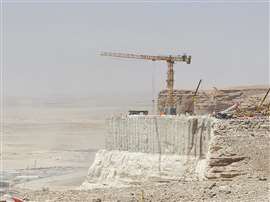 One of a total of 21 tower cranes NFT had on the Six Flags theme park project in Qiddiya, not far from Riyadh. Photo: NFT
On the construction side, US firm Bechtel has had a long presence in the Kingdom, starting with building oil refineries in the 1940s and also playing a leading role in the construction of Al Jubail – one of the largest industrial cities in the world. In 2023, Bechtel opened a new regional headquarters in Riyadh.
In the time since international firms helped build infrastructure like Al Jubail or King Khalid Airport, Saudi Arabia’s own domestic construction industry has evolved. What the Kingdom looks for now in international construction partners has changed with it, Mr Alajlan pointed out.
“It’s different because now the country has a very good system. We have a good infrastructure. We have skilled talent, engineers, robust project management capabilities. So now what we are seeing in the construction sector in Saudi is high-quality international companies who come because we have high-quality, state-of-the-art projects.”
Green buildings are also high on the agenda, as a result of Saudi Arabia’s target of reaching net zero carbon emissions by 2060.
“What we need now is deeper knowledge transfer and advanced technology through genuine partnerships with international companies. Part of the reason for our visit here to Paris and participating in a CICA event is to expand our network and to cooperate with the international main players in this industry,” Mr Alajlan said.
Providing reassurance to international partners
As part of its remit, the SCA has developed its own suite of standard electronic contracts which aim to ensure fairness and reduce the risk of disputes. It has also developed a consortium platform to foster collaboration among companies and pool their resources for large-scale projects.
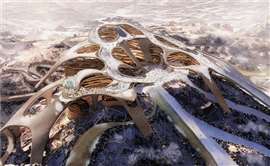 Render of the Neom Trojena Ski Village, which is currently under construction in Saudi Arabia’s Tabuk Province and scheduled to open in time for the 2029 Asiam Winter Games. (Image: Neom Trojena)
But the SCA also signalled an intention to go further on developing a contracting model that provides reassurance to international partners.
During its visit to Paris, the SCA signed a memorandum of understanding with FIDIC (International Federation of Consulting Engineers), which Mr Alajlan said was the start of a partnership aimed at promoting clear contracts that share risk between owners and contractors, and ultimately result in better project outcomes.
“FIDIC is no stranger to the Saudi market – it has been used in many projects,” he told Construction Briefing. “But our target is to spread it to a wider number of places and projects. This will build the culture inside the market between owners and between contractors so that there is greater sharing of risk. Because of the complexity of some projects and unknown risks, it is difficult to price work. You don’t wait for a dispute – you avoid the dispute by sharing the risk and being transparent.”
Embracing productivity and legacy
Mr Alajlan said he hoped to see Saudi Arabia’s construction industry industrialise with the aid of technology, moving to more offsite production to increase efficiency and reduce the reliance on manual labour, which, as in many other construction markets around the world, can be difficult to find.
He’s also keen to see further digitalisation of the sector and what artificial intelligence (AI) can do to push the industry forward as Saudi Arabia gears up to host Expo 2030 in Riyadh and then the FIFA World Cup in 2034.
And he is confident that the pavilions and stadiums being built for those occasions will find a legacy beyond the events themselves. “Saudi Arabia is building venues and infrastructure with long-term use in mind. With our growing population and rising demand for cultural, sporting, and business events, these facilities will remain active and well-utilised long after the major events they are built for,” he said.
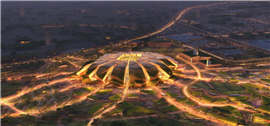 Digital render of the planned King Salman stadium in Riyadh, Saudi Arabia (Image: Populous)
Looking beyond those major events, he also envisages a future where Saudi Arabian construction companies expand their presence in the global market. “We need to come out of this megaproject with a stable and developed sector. With our expertise, we can export to a region like the Gulf states, or get involved in rebuilding Syria or rebuilding Yemen, or even go beyond into Africa, Asia, or even into Europe.
“A few Saudi contractors are already executing projects outside the Kingdom, including in Europe, and we aim to see this number grow significantly in the coming years. With the experience gained from our diverse and highly sophisticated national projects, Saudi companies are increasingly capable of competing internationally, and we expect to see more of them delivering major projects abroad. Hopefully one day we will see big Saudi companies doing major projects outside Saudi,” he said.
“The future of construction belongs to those who cooperate, innovate, and share knowledge. Saudi Arabia is ready to contribute, ready to partner, and ready to support, seek a global mission,” he concluded. “I look forward to welcoming them in Saudi Arabia for our next event, the Future Projects Forum (in Riyadh in December 2026). But let’s not wait to next year. Let’s work from today.”
STAY CONNECTED



Receive the information you need when you need it through our world-leading magazines, newsletters and daily briefings.

CONNECT WITH THE TEAM