Read this article in 中文 Français Deutsch Italiano Português Español
CICA president: Why better permitting, collaboration, and financing are key to solving global construction’s biggest issues

08 December 2025
Regardless of where they are based, there are certain challenges that are common to construction companies all over the world.
Among them are the issues of slow or complicated permitting, persistent labour shortages, tight financial conditions, and a worldwide housing affordability crisis.
Those are some of the challenges that Juan Armando Vicuña is working to solve during his term as president of the Confederation of International Contractors’ Associations (CICA).
Vicuña, who is also a board member for the Chilean construction firm RVC Co, spoke with Construction Briefing during CICA’s annual conference in Paris last month, which took urbanisation and the challenge of building resilient and dynamic cities as its central theme.
He discussed the trajectory of his presidency and his priorities, including a push to streamline permitting systems and advocate for greater emphasis on housing finance:
Looking back at your first 12 months, what do you consider the most significant achievements or progress made while you have been president of CICA?
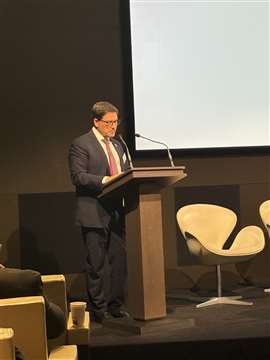 Juan Armando Vicuña, speaking at CICA’s annual conference in Paris, 21 November 2025 (Image courtesy of CICA)
In the field of international relations, one year is a relatively short period of time; however, I would highlight the admission of new member countries, which naturally strengthens our representativeness. I would also mention the kind invitations I have received to participate in conferences in non-member countries, where we hope to continue building relationships that may eventually lead them to join our organisation.
In terms of substantive work, we have been actively promoting the use of collaborative contracts in Latin America and supporting multilateral development banks (MDBs) in disseminating their project pipelines among companies in the region, with the aim of increasing competition in their procurement processes.
Another point worth highlighting is that our working groups have incorporated new topics into their agenda that we consider highly relevant, such as the use of artificial intelligence (AI) in construction, advocacy for simplifying permitting systems, and addressing the global housing-affordability crisis. This issue, in particular, has a direct impact on urban infrastructure, which often fails to materialise because the construction of new housing remains insufficient.
What areas do you feel still need more attention, and what are your priorities for the remainder of your term?
As I mentioned earlier, streamlining permitting systems is essential to achieving timely infrastructure delivery. This issue is so critical that the OECD organised the recent Simplifying for Success Symposium precisely to reflect on what should be done regarding permitting processes. We firmly believe that it is possible to uphold high standards of quality, sustainability, and safety while also having procedures that are fast, transparent, digitalised, and proportional to the level of risk they aim to mitigate. When discussing productivity, the focus is often placed on the use of technology within companies, but a key element is improving the processes that involve the public sector.
The second area that requires our full attention is the global housing-affordability crisis, which has now spread across all continents. We urgently need to understand and share the best international practices in order to help shift the trajectory of this situation. Housing shortages generate profound social challenges that may take several generations to resolve. At CICA, we want to serve as a platform where experiences can be shared and alternatives can be proposed. In addition, we aim to advocate for governments and MDBs to place greater emphasis on housing finance.
How do you define CICA’s role today in representing contractors internationally?
On the one hand, we aim to be a platform where companies and representatives from different countries can connect and find collaboration opportunities that might not otherwise exist. This allows them to expand their networks and explore opportunities that may not be immediately apparent, whether due to historical or geographical reasons. In the current context, where globalisation is being questioned, we see this role as particularly important.
On the other hand, we strive to provide our insights and recommendations to MDBs and organisations such as the OECD. These multilateral organisations cover a wide range of productive and social sectors, and they are not necessarily experts in the technical and financial challenges faced by our industry. Our role, therefore, is to bring these challenges, carefully diagnosed, and propose solutions that directly facilitate the awarding and execution of projects.
We believe that by focusing on these two main agendas, we can effectively represent the interests of our members.
What do you see as the biggest structural challenges facing contractors worldwide?
Wherever you go, skilled labour shortages are always an issue. There is something happening in our industry that makes many young people feel less attracted to it, and we have a responsibility to show that this sector also incorporates advanced technology, including artificial intelligence, and, above all, that construction has a profound social impact by improving people’s quality of life. I believe these elements can be highly motivating for younger generations, and we need to communicate them more effectively.
However, one of the most pressing challenges today is the tightening of financial conditions. We need more innovative financial instruments capable of attracting private capital: whether through guarantees, insurance mechanisms, or other tools that enable access to cheaper financing for new projects, particularly in areas where they are most urgently needed. In this regard, green financing has begun to show positive results, at least in developed countries. Yet, the developing world remains far behind, and environmental regulations are still often perceived as an additional cost rather than as an opportunity to access preferential financing.
Finally, I would highlight the importance of long-term infrastructure planning. Too often, the social and economic impacts of infrastructure are underestimated. Infrastructure lies at the very core of a country’s development. When viewed through a long-term lens, investment in infrastructure generates tremendous benefits for society. both economically and socially. The key is to plan strategically, with a long-term perspective, to avoid white elephants.
Where do you think productivity gains are most likely to come from, and how can industry bodies help accelerate wider adoption of new technologies?
There are several areas, but I would like to highlight three: The first is streamlining permitting processes, which I have already mentioned, and where the public sector plays a key role. The other two areas are related to the use of collaborative contracts to accelerate project delivery. Here, there is also a shared responsibility with the public sector, as they could incorporate these contracts into their procurement processes, while at the same time there is the challenge of applying them in private tenders for productive infrastructure.
STAY CONNECTED



Receive the information you need when you need it through our world-leading magazines, newsletters and daily briefings.



CONNECT WITH THE TEAM