Read this article in 中文 Français Deutsch Italiano Português Español
Architects unveil designs for California High-Speed Rail stations

01 July 2024
Foster + Partners and Arup have revealed the latest designs for California High-Speed Rail’s first four stations.
The team is overseeing the architecture and engineering for the new Central Valley stations, which will serve as models of design for others planned along the entire 500-mile Los Angeles/Anaheim to San Francisco system.
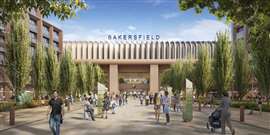 Image: Foster + Partners/ Arup
The first four California High-Speed Rail stations will be located: in the cities of Merced and Fresno; at Kings Tulare, which is close to the city of Hanford, and at Bakersfield, which will be the southern terminus of California High-Speed Rail’s Central Valley initial segment and is expected to one day provide connections to Los Angeles.
California High-Speed Rail is currently under construction in the state’s Central Valley with the goal of having the first operable line complete between 2030-2033.
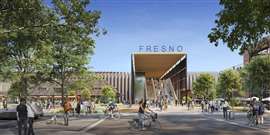 Image: Foster + Partners/Arup
California Rail was first proposed in 2008 as a bullet train service which will one day allow passengers to travel from Los Angeles to San Francisco in under three hours and take approximately half a million cars off the road annually.
However, the project has been beset by delays and spiralling costs. Initial construction efforts are focussing on the medium sized cities in the inland Central Valley with proposals to connect San Francisco and LA pushed into the future.
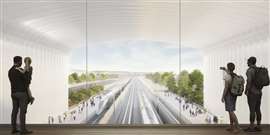 Image: Foster + Partners/ Arup
Stefan Behling, Head of Studio, Foster + Partners, said: “We are honoured to be part of this once-in-a- generation project that will connect California’s urban fabric with the agricultural heartland, transform local communities, and completely revolutionize the way people travel across the state. We are developing an architectural language for the four Central Valley stations, including soaring canopies that draw in fresh air and shield waiting passengers from harsh sunlight. The station design reflects the sustainable ethos of the wider project.”
STAY CONNECTED



Receive the information you need when you need it through our world-leading magazines, newsletters and daily briefings.

CONNECT WITH THE TEAM