Read this article in 中文 Français Deutsch Italiano Português Español
Bauer launches second phase of deep-sea mining research project

20 October 2025
At the end of September, a consortium of industry and research partners gathered at the headquarters of Bauer Maschinen to launch the second phase of the Deep Sea Sampling II (DSS II) project.
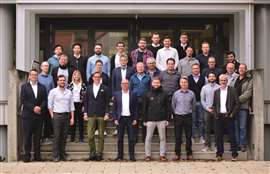 The project aims to develop and evaluate new technological approaches for the potential exploration of deep-sea mineral deposits. Image: Bauer
The project aims to develop and evaluate new technological approaches for the potential exploration of deep-sea mineral deposits, with a strong focus on environmental protection and reducing ecological impact. The research is funded by Germany’s Federal Ministry for Economic Affairs and Energy (BMWi).
According to Bauer, in the coming decades population and economic growth will drive demand for raw materials that recycling and the circular economy alone cannot meet.
The global shift toward a digital, electrified and decarbonised society will also require greater mining of strategically important minerals and metals – while expectations for higher ecological and social standards continue to rise.
The DSS II project addresses this challenge by examining the potential of deep-sea minerals as an alternative source of raw materials.
First phase of project
During the first project, Deep Sea Sampling I (2021–2024), partners explored the technical feasibility of a compact, electrified deep-sea cutter based on Bauer’s diaphragm wall method.
This system enables a closed-circuit process that prevents contamination from entering the marine environment. Seawater and rock particles are separated directly on the sea floor, and the treated fluid is returned to the process. This eliminates the need for an energy-intensive pump system reaching the surface.
The second project phase, running until 2028, will take a holistic view of marine resources, assessing both ecological and economic factors. Researchers will gather further geological and environmental data to support this work.
The team also plans to develop a lightweight, compact deep-sea platform capable of operating at depths of up to 4,000m, designed to extract rock samples selectively at multiple locations – a preliminary step toward a minimally invasive mining concept based on vertical cutter technology.
“Raw materials such as copper are essential for the energy transition and digitalisation,” said Dr Matthias Semel, project coordinator at Bauer Maschinen. “Deep Sea Sampling II aims to identify ways of extracting these metals with minimal impact on the natural environment.”
STAY CONNECTED



Receive the information you need when you need it through our world-leading magazines, newsletters and daily briefings.

CONNECT WITH THE TEAM