Read this article in 中文 Français Deutsch Italiano Português Español
External wall insulation installed under UK government scheme had 98% failure rate

14 October 2025
Almost all homes fitted with external wall insulation under a UK government scheme that aimed to reduce carbon emissions and tackle fuel poverty have major faults that require repair, according to a new report.
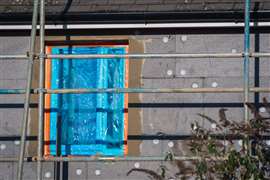 External wall insulation panels installed on house in England (Image: Jevanto Protography via AdobeStock)
The National Audit Office’s (NAO) new report examines the effectiveness of retrofit work undertaken under the Energy Company Obligation (ECO) scheme.
The watchdog found that 98% of properties with external wall insulation installed through the ECO programme need work to fix serious issues such as damp and mould. A further 29% of homes with internal insulation were also found to have significant defects.
The report attributes the widespread failures to poor workmanship, weak oversight by the Department for Energy Security and Net Zero (DESNZ), and a consumer protection system, set up in 2021, that failed to detect problems until late 2024. The ECO scheme is funded by energy companies to install efficiency measures in homes.
According to the NAO, an under-skilled and poorly supervised workforce, inconsistent standards, and “corner-cutting” by contractors led to tens of thousands of defective installations. The department’s oversight system, run through the TrustMark quality scheme, did not alert officials to the scale of the problems until after media reports highlighted cases of severe damp.
Ofgem has also identified potential fraud within the scheme, estimating that businesses may have falsified claims for between 5,600 and 16,500 homes, worth up to £165 million.
The NAO has called on DESNZ to take responsibility for repairing affected homes, reform the consumer protection framework, and publish annual estimates of fraud and non-compliance in all retrofit programmes.
DESNZ and energy industry regulator Ofgem started taking action once TrustMark made them aware of the extent of the problems. This included suspending the worst-performing installers, and informing affected households.
The department also plans to apply lessons from the experience to the design of future schemes and its forthcoming Warm Homes Plan.
“Clear failures in the design and set-up of ECO and in the consumer protection system have led to poor-quality installations, as well as suspected fraud,” said Gareth Davies, head of the NAO. “DESNZ must now ensure that businesses meet their obligations to repair all affected homes as quickly as possible. It must also reform the system so that this cannot happen again.”
STAY CONNECTED



Receive the information you need when you need it through our world-leading magazines, newsletters and daily briefings.



CONNECT WITH THE TEAM