Read this article in 中文 Français Deutsch Italiano Português Español
Engineers in successful test of mini dam inspection robot

01 September 2025
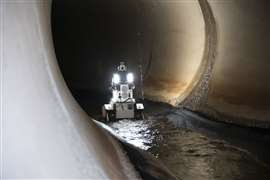 The DamBot Mini, an unmanned robotic inspection platform developed by team members at the U.S. Army Engineer Research and Development Center (ERDC) Information Technology Laboratory (ITL) (Image courtesy of USACE)
A miniature robot capable of undertaking inspections in dangerous and hard-to-reach areas of dams has completed a successful test on the Alamo Dam on the Bill Williams River in Arizona, USA.
The DamBot Mini is an unmanned robotic inspection platform developed by the US Army Engineer Research and Development Center (ERDC) Information Technology Laboratory (ITL).
As its name suggests, the DamBot Mini is a smaller version of the DamBot, winner of the 2021 USACE Innovation of the Year Award.
Like its larger counterpart, it contains a variety of sensors such as high-resolution cameras and LiDAR to allow remote inspection
It allows for a first-pass visual inspection of the more dangerous parts of dam structures, which are inaccessible to human inspectors due to hazardous conditions like at the Alamo Dam where the presence of hydrogen sulphide gas in the outlet prevents human entry for much of the year.
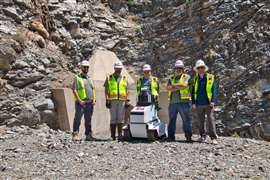 Team members at the U.S. Army Engineer Research and Development Center (ERDC) Information Technology Laboratory (ITL) on a test of the DambotMini at Alamo Dam in Arizona, USA (Image: USACE)
Jordan Klein, a research computer engineer in the Sensor Integration Branch, said, “Alamo Dam has some structural design quirks that made it very interesting for us to perform a field test to make sure our technology could operate in challenging conditions such as very small spaces and curvature in the outlet itself.
“There are also risks from the hydrogen sulphide gas, which added an extra element. Still, we were able to successfully enter the conduit and navigate the tight spaces and curvature with no problems, capturing visual and lidar data along the way.”
Based on lessons learned at the Alamo Dam, the team will now make modifications and hopes to test the platform against other technologies, including handheld systems and possibly aerial platforms.
STAY CONNECTED



Receive the information you need when you need it through our world-leading magazines, newsletters and daily briefings.



CONNECT WITH THE TEAM