Read this article in 中文 Français Deutsch Italiano Português Español
Industry associations and European Commission VP address fair work and skills in construction

17 March 2025
The European Federation of Building and Woodworkers (EFBWW) and the European Construction Industry Federation (FIEC) invited Roxana Mînzatu, the European Commission’s executive vice-president for Social Rights, Skills, Quality Jobs, and Preparedness, to join them on a visit to the Oosterweel project in Antwerp, Belgium.
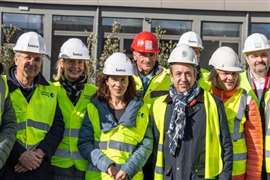 During the visit, trade unions, employers and the Commission discussed the attractiveness of the construction sector, skills, safety, labour shortages and quality jobs (Photo: FIEC)
Belgian sectoral social partners, including CG FGTB, ACV-BIE, and Embuild, were also present.
The primary goal of the visit was to raise awareness about the complexities of a construction worksite, including coordination among various stakeholders, worker safety, technical and logistical challenges, and collaboration between workers from different nationalities.
During the visit, trade unions, employers, and Commission representatives discussed the attractiveness of the construction sector, including issues related to skills, safety, labour shortages, and quality jobs. Participants observed best practices in place, such as the use of social ID cards and the impact of subcontracting limits in Belgium. They also had the opportunity to interact with construction workers and listen to their testimonies about the unique aspects of the sector and their experiences at work.
EFBWW and FIEC stressed their joint compromise in promoting fair competition and providing good working conditions, such as fair wages, equal treatment, training opportunities, and avoiding long subcontracting chains.
As the European Commission is preparing its Quality Jobs Roadmap, EFBWW and FIEC have called on EVP Mînzatu to support the sectoral social dialogue and work closely together with the sectoral social partners on all these topics.
Roxana Mînzatu, said, “My ambition is to launch a labour mobility package which can address the needs of workers and businesses. This will include four main pillars: strengthening the European Labour Authority, digitalisation, posting of workers from third countries, and sub-contracting.
“On this topic, I want to actively engage with Member States and social partners to secure workers’ rights in supply chains. Transparency, equal treatment, decent work and effective enforcement should be enhanced throughout sub-contracting chain to fight against social dumping and unfair competition.”
STAY CONNECTED



Receive the information you need when you need it through our world-leading magazines, newsletters and daily briefings.



CONNECT WITH THE TEAM