Read this article in 中文 Français Deutsch Italiano Português Español
Robotic ‘microfactory’ to rebuild homes after California wildfires

07 August 2025
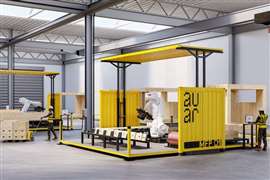
A mobile robotic ‘microfactory’ developed by Cosmic Buildings and powered by ABB Robotics has started operations in Pacific Palisades, California, US, to help rebuild homes destroyed in this year’s Southern California wildfires.
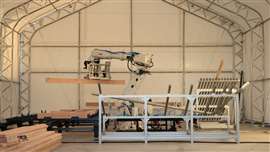 An ABB robotic arm works inside a “microfactory”. Image: ABB
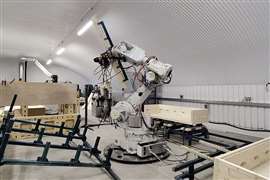
The initiative uses tech and engineering firm ABB’s IRB 6710 industrial robots and RobotStudio digital twin software in combination with California-based Cosmic’s AI-driven building information model (BIM) to fabricate structural wall panels on-site.
According to the companies, the system reduces build time by up to 70% and cuts construction costs by about 30% compared to conventional methods.
Cosmic estimates homes can be delivered in as little as 12 weeks at US$550–$700 per square foot, below the typical Los Angeles range of $800–$1,000.
The Los Angeles deployment follows the Palisades and Eaton wildfires, which destroyed more than 16,000 structures across the region. Cosmic’s goal is to build 100 homes by 2027, using non-combustible materials, greywater recycling, solar and battery systems, and other resilience features that exceed California’s building codes for fire and energy.
Marc Segura, president of ABB’s Robotics Division, said, “By integrating our robots and digital twin technologies into Cosmic’s AI-powered mobile microfactory, we’re enabling real-time, precision automation ideal for remote and disaster-affected sites.”
ABB said each microfactory includes a Robotic Workstation Cell that fabricates panels with millimetre precision. Computer vision and AI systems guide fabrication and detect errors in real time. The entire process, from design and permitting to assembly, can be simulated and optimised before deployment.
ABB noted the pilot is part of a wider strategy to expand automation across the building sector in response to global labour shortages, cost pressures, and growing demand for more sustainable building methods.
STAY CONNECTED



Receive the information you need when you need it through our world-leading magazines, newsletters and daily briefings.


CONNECT WITH THE TEAM