Read this article in Français Deutsch Italiano Português Español
Costain trials concrete sensor technology

09 April 2024
Costain, a UK-based construction company, has been using Maturix’s concrete sensors to monitor the temperature and strength of concrete as it sets.
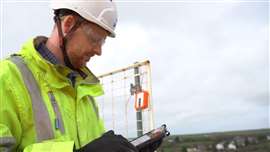 Costain says that the introduction of these sensors has reduced the time that the formwork is in place by around 33% (Photo: Costain)
These sensors, called Gaia 200, are said to be the size of a large smartphone and provide real-time data wirelessly to engineers, temporary works designers, and other contractors.
This information helps them make informed decisions about when to remove the formwork following a concrete pour. On average, Costain says that the introduction of these sensors has reduced the time that the formwork is in place by around 33%. Previously, concrete pours were tested by physically removing cube samples to be examined under lab conditions.
However, the ability to record readings directly and accurately from sensors means that these tests are no longer needed.
One of Costain’s projects has used the sensors for over 80 different pours and structures, eliminating the need for destructive testing of approximately 500 strike cubes.
Bhavika Ramrakhyani, head of materials at Costain, commented, “We have an important role to play in maximising efficiency for our customers without compromising on quality or safety. It is important that our engineers have instant access to the right information at the right time, with crucial information sent directly to their devices and laptops. This means they can make informed decisions to accurately determine when it is safest to remove the temporary falsework and formwork after a pour.
“We’ve already seen enormous efficiency benefits. Programme delivery speeds have improved considerably, with striking times reduced by a third on sites where we have used the sensors. At the same time, the technology enables us to repurpose and reuse more of our temporary structures, as well as reducing the quantity of materials used, lowering our carbon footprint, which is another major benefit.”
STAY CONNECTED



Receive the information you need when you need it through our world-leading magazines, newsletters and daily briefings.
CONNECT WITH THE TEAM