Austria’s first 3D-printed building

11 November 2021
Austria’s first 3D-printed building is being constructed in Hausleiten, Lower Austria
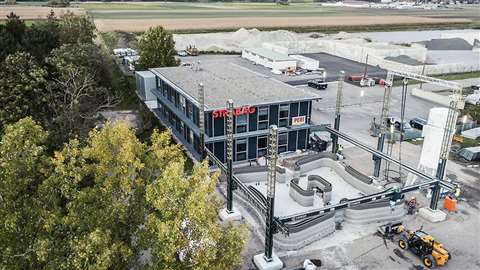 The first 3D printed building in Austria
Construction technology group Strabag and scaffolding manufacturer Peri are constructing Austria’s first 3D-printed building in Hasuleiten.
The project is an approximately 125m² office building. The pure printing time for the building extension is roughly 45 hours.
Peri are experienced in 3D concrete printing and are using a special dry mortar for the construction called ‘Tector Print’ which is being supplied by Lafarge.
“3D construction printing brings an important innovation impulse for the construction industry and is an exciting addition to other construction methods,” said the Strabag board member responsible for digitalisation and innovation, Klemens Haselsteiner.
“With this practical test, we want to further develop 3D construction printing together with our partners Peri and Lafarge. In Hausleiten, we were already able to achieve important findings for future use during the joint planning.”
Thomas Imbacher, chief innovation and marketing officer at Peri AG, said that, “At Peri, we see great potential in the still young technology of 3D construction printing. Just under a year ago, we printed Germany’s first residential building with a BOD2 printer from our Danish partner COBOD.”
Peri will be using the COBOD BOD2 gantry printer supplied from the Danish manufacturer COBOD. With this technology, the print head moves over three axes on a permanently installed metal frame meaning it can move to any position within the construction and only needs to be calibrated once.
Including this printing project in Hausleiten, the PERI 3D construction printing team has successfully completed five printing projects in one year. The first ever printed house in Germany, the first multi-family house and largest printed building in Europe (Wallenhausen), its first printed house in the US, an apartment building extension in Lindau, Germany and the project in Hausleiten.
These are not research projects, but real houses that have gone through all the building code approval processes, are rented out and occupied, or in which people work.
STAY CONNECTED



Receive the information you need when you need it through our world-leading magazines, newsletters and daily briefings.


CONNECT WITH THE TEAM