Read this article in 中文 Français Deutsch Italiano Português Español
Weekly quiz: Why is nuclear so expensive to build in UK? What’s the Open-S Alliance?

27 November 2025
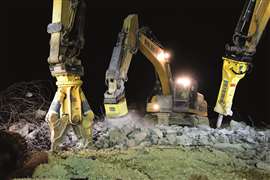 An Epiroc breaker, cutter, and magnet on excavators (Image: Epiroc)
It’s the Construction Briefing weekly news quiz. How much attention have you been paying to events in the world of construction over the past seven days?
1) The UK government has recently selected a scheme for a new runway at Heathrow Airport. Which of the following correctly describes the plan approved?
- A 2.2-mile north-western runway that would cross and require rerouting of the M25 motorway.
- A shorter runway to the east of the airport that avoids any disruption to the M25.
- Expansion of one of Heathrow’s existing runways.
2) Korean construction firm Samsung C&T E&C Group has announced a plan to become “AI native” by 2028. What does that ambition involves and how they plan to achieve it?
- All construction workflows and decision-making will be driven by internally developed AI agents.
- The firm will outsource all design and project-planning tasks to third-party AI consultancies by 2028 to reduce staffing costs.
- The firm aims to become “AI native” by replacing on-site workers with autonomous robots by 2028.
3) Epiroc, Genesis Attachments and Kanamoto have recently joined Open-S Alliance. What is the primary purpose of that alliance?
- To create a global, open standard for fully automatic quick-couplers, allowing excavator couplers, tilt-rotators and tools from different manufacturers to work together.
- To establish a new joint venture for marketing heavy-equipment attachments in North America and Asia.
- To mandate that all excavators worldwide switch to a single manufacturer’s coupler type by 2030.
4) Recent analysis suggests the UK is now the most expensive country in which to build a nuclear power plant. According to that reporting, which of the following is one of the three main drivers behind this high cost?
- The UK’s unusually high cost of nuclear fuel compared with other countries.
- A fragmented and overly complex regulatory and environmental-permitting regime, involving multiple layers of oversight and review.
- The lack of domestic demand for electricity, which reduces economies of scale and increases per-unit construction cost.
5) Contractors have been appointed to build the Fehmarn Sound Crossing in Germany. What function will the new crossing serve within the wider Fehmarnbelt corridor between Germany and Denmark?
- It will replace the Fehmarnbelt tunnel as the primary cross-border connection.
- It will provide the essential road and rail link between the German mainland and the Fehmarnbelt tunnel portal on Fehmarn island.
- It will handle only rail traffic, with road traffic continuing to use the existing bridge.
STAY CONNECTED



Receive the information you need when you need it through our world-leading magazines, newsletters and daily briefings.


CONNECT WITH THE TEAM