Read this article in 中文 Français Deutsch Italiano Português Español
Two firms to deliver first carbon capture scheme in UK cement sector

08 December 2025
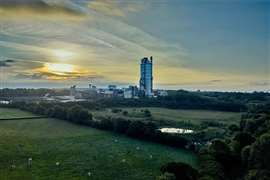 The Padeswood Cement Works in Flintshire, Wales, United Kingdom (Image courtesy of Heidelberg Materials)
Mitsubishi Heavy Industries and Australia-based engineering firm Worley have moved into the execution phase of a carbon capture and storage (CCS) scheme at Heidelberg Materials’ Padeswood cement works in north Wales.
The facility, estimated to cost £400 million (US$534 million) is set to become the first full-scale project of its kind in the UK cement industry.
Scheduled to start operations in 2029, it is designed to capture around 800,000 tonnes of CO₂ each year. The project will use MHI’s Advanced KM CDR (Kansai Mitsubishi Carbon Dioxide Recovery) Process, marking its first deployment in Europe.
The captured CO₂ will be transported by pipeline for permanent storage in depleted gas fields under Liverpool Bay.
The development follows Heidelberg Materials’ final investment decision in September, made in collaboration with the UK government, which has a programme of support for industrial decarbonisation through carbon capture and storage.
MHI and Worley were awarded a front-end engineering design (FEED) study in 2024 and will now deliver engineering, procurement and construction management across the capture plant and associated systems.
Cement production is responsible for around 7-8% of CO2 emissions globally. Since most of these emissions come from the chemical process (calcination), they cannot be avoided by switching to clean energy sources. This leaves CCS as the only viable option for fully decarbonized production, according to Mitsubishi.
The partners expect the project to support up to 500 construction roles and create about 50 long-term jobs, while securing more than 200 existing positions at the site. Heidelberg Materials said the scheme will enable the production of near-zero carbon cement from 2029 as part of wider plans to decarbonise its UK operations.
Simon Willis, CEO at Heidelberg Materials UK, said, “This is the next major milestone in our plans to build the UK’s first carbon capture facility at a cement works. We have established an excellent working relationship with Worley and MHI during the completion of the front-end engineering design (FEED) for our Padeswood project. This, along with their proven track record in delivering this type of complex facility, makes them the perfect partner to take our groundbreaking project to the next stage.”
STAY CONNECTED



Receive the information you need when you need it through our world-leading magazines, newsletters and daily briefings.

CONNECT WITH THE TEAM