Three new Chinese partnerships for Deutz

18 December 2018
German-based engine manufacturer Deutz is restructuring its market presence in China, entering into partnerships with three Chinese companies: Sany, Horizon and Beinei.
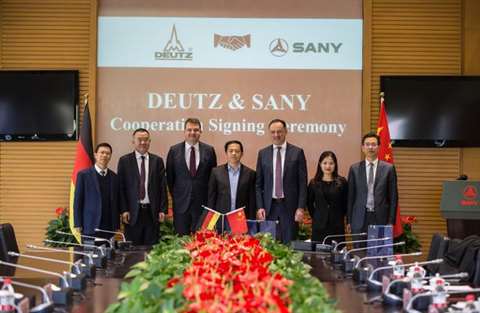
“China is the largest individual market for engines in the world,” said Dr Frank Hiller, Chairman of the Deutz Board of Management.
“Thanks to its new partners, Deutz now has the ideal production network for efficiently supplying local customers with Deutz drive systems. At the same time, we have access to an extensive service network that we will systematically enhance with digital solutions.”
Deutz and Sany, one of China’s largest construction equipment manufacturers, recently signed a memorandum of understanding in Beijing. The two companies are forming a joint venture in which Deutz will be the majority shareholder, with a stake of 51%.
Initially, Deutz will supply Sany with around 75,000 new engines for off- and on-road applications in 2022. These engines will comply with China 4 and China 6 emissions standards. Deutz’s initial investment in the new joint venture has not been disclosed.
Liang, a member of the Sany Group’s board of directors, said, “In this joint venture, we will benefit from working with an agile company that is looking to the future and driving forward technological innovation. Deutz thus brings to the table exactly what we need for our engine development.”
The latest Yellow Table – International Construction’s ranking of the top 50 original equipment manufacturers in the world by revenue – saw Sany ranked at number eight, with revenues of just under US$6 billion.
In addition to Sany, Deutz is entering into a cooperation agreement with Horizon, one of the leading companies in the Chinese construction equipment rental business. Horizon will become a local service partner for Deutz, servicing engines in the field and taking over the aftermarket sales business in China.
The third Chinese partnership is a local contract manufacturing alliance with engine manufacturer Beinei, which will act as a production hub for the Asian market. The Deutz management team is to oversee the manufacturing of approximately 20,000 engines in 2022 at a new factory in Tianjin, in the north of China.
In October 2018, Deutz sold its shares in Deutz Dalian, the Chinese joint venture that it had entered into with First Automotive Works. The new strategy enables Deutz to overhaul its market presence so that it can meet the growing demand for sophisticated engines, in China and other Asian markets.
Following these new partnerships, the company is aiming to generate revenue of approximately half a billion euros in China in 2022.
STAY CONNECTED



Receive the information you need when you need it through our world-leading magazines, newsletters and daily briefings.

CONNECT WITH THE TEAM