Read this article in 中文 Français Deutsch Italiano Português Español
Interview: Case Construction on market peaks, tech disruption and a fragmented global recovery

28 May 2025
As global construction faces a cyclical shift, Fabrizio Cepollina, head of construction equipment EMEA at Case Construction Equipment, discusses the sector’s emerging trends – from regional divergence to remote-controlled machines.
 Rather than sharply differentiating between developed and emerging markets, Case tailors its product lines based on customer needs, affordability, and infrastructure maturity (Photo: Case Construction Equipment)
The global construction industry is entering a new phase. For seasoned observers, it’s a familiar pattern – growth slows, markets consolidate, and confidence wavers. Yet as Fabrizio Cepollina, head of construction equipment EMEA at Case Construction Equipment, makes clear, today’s downturn is unfolding under a different set of pressures, and with new opportunities on the horizon.
“Today we are at a peak in the market. There is a cycle in this industry,” he says. “If you compare the general market level, it dropped from 2022 to 2023. And within that, markets like the UK and the Nordics saw a significant drop. But honestly, the market outlook ahead looks good. There’s a healthy base for construction equipment.”
Far from being pessimistic, Cepollina points to the underlying strength of demand in many regions, noting that Europe’s slowdown is more a pause than a collapse.
“During this difficult moment, I’ve been speaking with German dealers. They’re all waiting for government incentives to be approved. Once that happens, infrastructure and real estate construction will naturally pick up again.”
The year ahead, he says, will be one of rebalancing. “We think things could improve, perhaps in 2026. Between now and then, we expect some countries will grow, others may decline – a bit of a reshuffle. But no major growth against 2024.”
A fragmented future
Case Construction Equipment anticipates a patchy recovery, with growth returning at different speeds across individual countries. The company sees opportunities in several mature markets, but the most striking growth is forecast in emerging economies across the Middle East and Africa.
“If we look at the rest of my area of responsibility – Africa and the Middle East – 2024 was a peak,” Cepollina says. “Some markets are pushing ahead strongly. South Africa is a key market for us, and we’re doing very well there. The Middle East is also growing – Saudi Arabia especially is at a very high level. Some projects may slow slightly, but important infrastructure initiatives are coming through.”
These comments reflect broader sector sentiment around the Middle East’s infrastructure boom, with Saudi Arabia in particular committing to megaprojects such as Neom and Vision 2030-related developments.
 Fabrizio Cepollina, head of construction equipment EMEA at Case Construction (Photo: Case Construction Equipment)
Adapting to local realities
Rather than sharply differentiating between developed and emerging markets, Case tailors its product lines based on customer needs, affordability, and infrastructure maturity. While cost is a central factor in emerging regions, the appetite for practical technology is growing fast.
Cepollina explains that “in emerging markets, we focus more on product cost and offer a range – a premium line and a value line. For sure, certain technologies and standards are more suited to sophisticated markets, like in Europe. But increasingly, we see this technology being used everywhere.”
Technology, once the preserve of top-end machines, is filtering down, according to Cepollina, who says, “Emerging market manufacturers are also investing in technology, so now we see baseline technology that is easy to use and well-connected. That’s what we’re showing here [at Bauma] – technology that is ready to be used straight away.”
The shift to connected, data-driven construction machinery is one of the most important transitions facing the industry, according to Cepollina. He pointed to the role of machine connectivity in improving after-sales service, uptime and lifecycle cost.
“From a business point of view and the customer’s perspective, what excites me is what guarantees customer satisfaction, like return on investment and reduced total cost of ownership.”
Connectivity is a big part of that, and improving aftermarket control and machine uptime are crucial. For the construction industry, being able to forecast spare parts availability and repair times has always been a challenge, but today’s technology already helps.
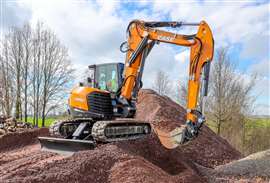 Case CX100E (Photo: Case Construction Equipment)
Progress, with limits
As the industry faces mounting regulatory and environmental pressure, electrification is widely seen as a key part of the solution. Cepollina agrees – but only to a point.
“I don’t want to just talk about a mix of solutions – that’s already the direction passenger cars have taken. Of course, the green economy is one point of view, and the reality is that we must expect that electrification is one of the solutions.
“There are definitely applications where electric machines make sense,” he adds. “That’s why we offer electric mini excavators. They’re ideal for urban areas or enclosed environments where recharging is straightforward.”
But Cepollina believes that, for heavier machines in remote areas, electrification is more of a challenge. It depends on how battery technology develops in terms of durability and cost, but there is space for growth.
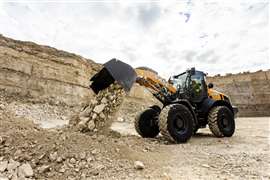 Case 421G wheeled loader (Photo: Case Construction Equipment)
Stage V and what comes next
Europe’s adoption of Stage V emissions standards has raised questions about what lies ahead. Cepollina suggests the next major regulatory shake-up will most likely come from the US, but remains cautious about how realistic any new standards might be.
“With Stage V emissions, we’re at a certain level now,” he says. “The next move is expected in the United States, with Tier 5 – but there’s still some doubt around that. It could bring much stricter requirements, but it’s not clear yet, and might not align with what the market is ready for.”
That said, he stresses that emissions reforms have already demanded – and received – a massive investment from manufacturers and customers alike.
Europe adopted Stage V, China made a big leap two years ago, and countries like Turkey, Israel and India have followed. That involved a major investment. So, going forward, Cepollina expects to see gradual upgrades in other countries and across more product lines.
Competing on innovation and resilience
As Case adapts to new technologies, shifting regulations, and uneven growth patterns, it is clear that the industry is redefining itself. The next few years will demand agility, responsiveness, and a renewed focus on value – for customers, operators, and the wider built environment.
“There are many challenges. Construction is a highly competitive sector – far more so than others like agriculture, where there is more stability,” says Cepollina.
He adds that geopolitics plays a role in construction challenges, especially between the players and the policies that they are trying to implement solutions for.
“But that’s also exciting,” he enthuses. He offers a succinct reminder that, in a changing world, agility matters. “If you are not focused and ready to present a new solution, then you risk being out [of the market] quickly. To be in the game, you need to innovate and be close to the people who need the innovation.”
It’s not rocket science, Cepollina concludes, but about being “alive” to the needs of the market and progress.
STAY CONNECTED



Receive the information you need when you need it through our world-leading magazines, newsletters and daily briefings.


CONNECT WITH THE TEAM