Read this article in 中文 Français Deutsch Italiano Português Español
Carbon-sink cement deployed in Rotterdam in push to cut emissions

18 June 2025
Dutch-based construction and engineering firm Hakkers has used carbon-storing cement at a project at the port of Rotterdam.
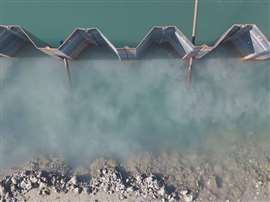 Paebbl says its material offers permanent CO₂ storage, with the capacity to permanently sequester up to 300 kg of CO₂ for every 1,000 kg produced. Image: Hakkers
Hakkers has partnered with Paebbl, which produces the carbon-storing cement, at the port of Rotterdam where 15% of the traditional cement has been replaced with the carbon-storing material.
According to a press release, this will trap approximately 110kg of CO₂ that would have otherwise entered the atmosphere.
“We’re always on the lookout for innovative ways to minimise our carbon footprint at industrial scale. Traditional anchoring systems rely heavily on cement, which generates considerable CO₂ emissions,” said Jeroen Kuup, commercial manager at Hakkers Foundations.
Paebbl’s material offers permanent CO₂ storage, with the capacity to permanently sequester up to 300 kg of CO₂ for every 1,000 kg produced. It can also lead to a significant reduction in embodied carbon, with their materials serving as a partial cement replacement beyond its storage capabilities and reducing embodied carbon in construction by up to 30%.
By accelerating natural mineralisation processes by a factor of a million, Paebbl locks CO₂ into stable mineral form instead of emitting it. This approach allows construction projects to embed carbon within building materials, transforming the built environment from a large emitter into a potential carbon sink.
“Carbon sink building solutions can be scaled up to industrial applications and we are delighted to see our product deployed in the field. Working with leading engineering firms such as Hakkers, and building Port of Rotterdam’s critical infrastructure, shows that carbon sink building solutions can be scaled up to industrial applications,” says Ana Luisa Vaz, VP Products at Paebbl.
According to industry research, cement accounts for 8% of global carbon emissions.
STAY CONNECTED



Receive the information you need when you need it through our world-leading magazines, newsletters and daily briefings.


CONNECT WITH THE TEAM