Read this article in 中文 Français Deutsch Italiano Português Español
Are hard hats up to the job? The case for rethinking head protection on site

17 June 2025
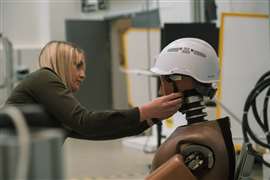 Image courtesy of Mips
Boxer Mike Tyson had a knockout-to-win percentage of 88% and was famous for sending his opponents to the canvas with a combination of brutal hooks and uppercuts.
While on the face of it that fact doesn’t appear to have much to do with construction health and safety, it does in fact tell us something important about the way the human brain responds to impacts.
The brain is soft like a gel and sits inside the skull surrounded by cerebrospinal fluid (CSF). Like a fluid, it can’t really be compressed. But when the head suffers an impact, the brain moves within the CSF, cushioning it against linear impacts. However, rotational energy – such as from a boxer’s hook – causes shearing and deformation, leading to injuries from concussion to worse.
Swedish neurosurgeon Hans von Holst, working at the Karolinska Institute in Stockholm, noticed that standard helmets were not providing sufficient protection against head injuries caused by rotational energy back in 1995.
Von Holst and two biomechanics experts – Peter Halldin and Svein Kleiven – developed a new safety system called Mips that sits inside helmets to protect against brain injuries.
Mips is a low-friction layer that ‘slips’ on impact to absorb energy and reduce rotational forces transferred to the skull.
Head injuries from different types of impact
Linear: Fracture, epidural hematoma, contusion.
Angled: Concussion, subdural hematoma (SDH), diffuse axonal injury (DAI)
From sports to construction
Mips has since grown far beyond its roots in academia. Initially, the company found success in various sports markets. Mips is now more or less ubiquitous in cycling helmets and also features in many motorcycle, equestrian, and ice hockey helmets to name just a few others.
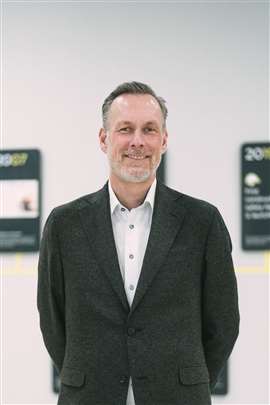 Mips CEO Max Strandwitz (Image: Mips)
More recently, the Swedish firm has turned its attention to the industrial segment. That was after research revealed that brain injury is also a problem in construction – one not properly addressed by conventional hard hats.
Examining accident data from Europe and North America, it found that there are five main causes of brain injury in construction, all of which can involve angled or rotational impacts: slips and falls; loss of control of a machine; falls from height; same-level falls; and ‘uncoordinated movements’.
Of those five, it’s falls to a lower level that most often result in worker fatalities. Hard hats can also fall off during falls, which is why Mips emphasises the importance of industrial helmets featuring a chin strap.
As an “ingredient brand”, the company doesn’t make its own helmets but sells the technology to other manufacturers and supports testing.
The first brand to put Mips into a construction helmet was Swedish firm Guardio and Mips has gone on to establish relationships with other major PPE companies like MSA Safety and PIP Global Safety in the US, Uvex in Europe, and Centurion in the UK.
From an admittedly low base, Mips’ sales in construction are doubling each year, says the company’s CEO Max Strandwitz. Interestingly, it is the North American market in particular that has embraced the technology, making up 85-90% of sales.
“We are seeing a big drive for improved personal protective equipment (PPE) in general in the US,” says Strandwitz. “Total safety equipment spend has doubled in the US in less than five years. If you look at project cost, it used to be 2% of the total and it is now 3-4%.”
The increase in spend appears to be at least partly as a result of major, safety-conscious clients urging contractors to up their game on PPE.
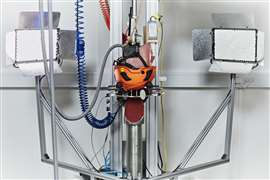 A construction helmet in a Mips test rig (Image: Mips)
Barriers to uptake?
Strandwitz puts the additional cost of a hard hat that features Mips as opposed to one without at about US$15-20 and a similar amount in Euros.
Cost is one of the challenges that stands in the way of wider adoption of Mips-equipped hard hats.
While North American contractors are upping their budget for PPE, some other markets, even those with a strong reputation for construction health and safety, are proving a tougher sell.
Strandwitz notes that Mips conducted a survey in the Nordic countries and found that the average construction worker spends €800 a year on PPE but only around €40 of that goes on a hard hat.
“It’s not like the budget isn’t there but maybe it should be allocated a bit differently. Europe has strong ESG programmes, sustainability programmes, safety commitments and so on, but it needs to translate those into real actions in the industry,” he argues.
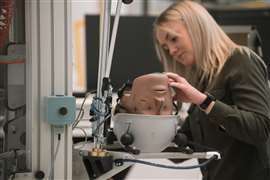 Image courtesy of Mips
There’s also a question mark over whether workers are prepared to tolerate wearing a helmet that requires a chin strap all day, when they are so used to wearing hard hats without them.
Strandwitz argues chin straps are more comfortable and with better education, uptake will improve.
“The best helmet is also the most comfortable helmet,” he says. “We find that the Mips system is considered to be more comfortable in blind tests because it has a plate construction that allows for better ventilation and a headband that absorbs sweat.
“We try to educate as many people as possible. We want them to have a chin strap on the helmet and if they choose Mips then that would be fantastic. But the key initiative for us is to make sure they have a helmet on their head. I think the saddest thing to see is that when people don’t wear a helmet, it is surprising how easily they can die – a lot of fatal accidents aren’t even from one metre.”
Meanwhile, the company is currently engaged in activities to raise awareness of the effects of rotational impacts and of Mips in the construction industry. “We also do a lot of round table discussions with the industry and go out and talk to the bigger construction companies. We are doing a big campaign in the US now about safety that targets the key 7,000-10,000 buyers and health and safety engineers at those companies because they are the ones who need to go and ask for a bigger budget,” he adds.
Strandwitz adds that industrial helmet standards are “going in the right direction” and are expected to be tightened up around the world gradually. He notes that existing tests for hard hats are decades old and don’t necessarily represent real-life accident scenarios. Eventually standards could oblige hard hat manufacturers to shield wearers from rotational impacts, although that isn’t currently the case.
Future developments
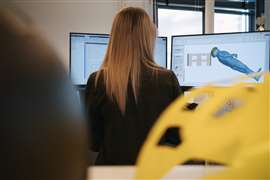 Image courtesy of Mips
Meanwhile, work in Mips’ labs in Stockholm Sweden, to further develop its safety system goes on. “We look at the accident statistics a lot and at the moment we are having a lot of discussions about the back of the head. A lot of retention systems are at the back: Is that the best placement? How much coverage should you have down the head? We see a lot of what we call “butt-first” accidents in construction, where you land on your butt first and your head swings backwards, for example,” says Strandwitz.
To assist in these investigations, the company is developing new testing rigs that recreate real-life scenarios, as well as a Virtual Test Lab Environment (VTL). The VTL is developing complex mathematical models that it hopes will reduce the time and cost involved in physical testing by accurately replicating and predicting responses to real-life impacts in a virtual environment.
As a new type of industrial helmet starts to make in-roads into the construction market, Strandwitz concludes, “I hope that we get rid of all the [conventional] hard hats because there are very few cases when they actually make sense in the type of accidents that we normally try to address.”


CONNECT WITH THE TEAM